

19 Apr Sustainability Has a Communication Problem and the Industry Keeps Pretending It Doesn’t
Is the industry's biggest problem the one nobody wants to talk about?
Hello and welcome back to Frayed Not!
Our mission is to remind you that change doesn’t need to be perfect, just possible!
Whether you are a sustainability specialist, brand or consumer, we are here to accelerate change in the apparel industry.
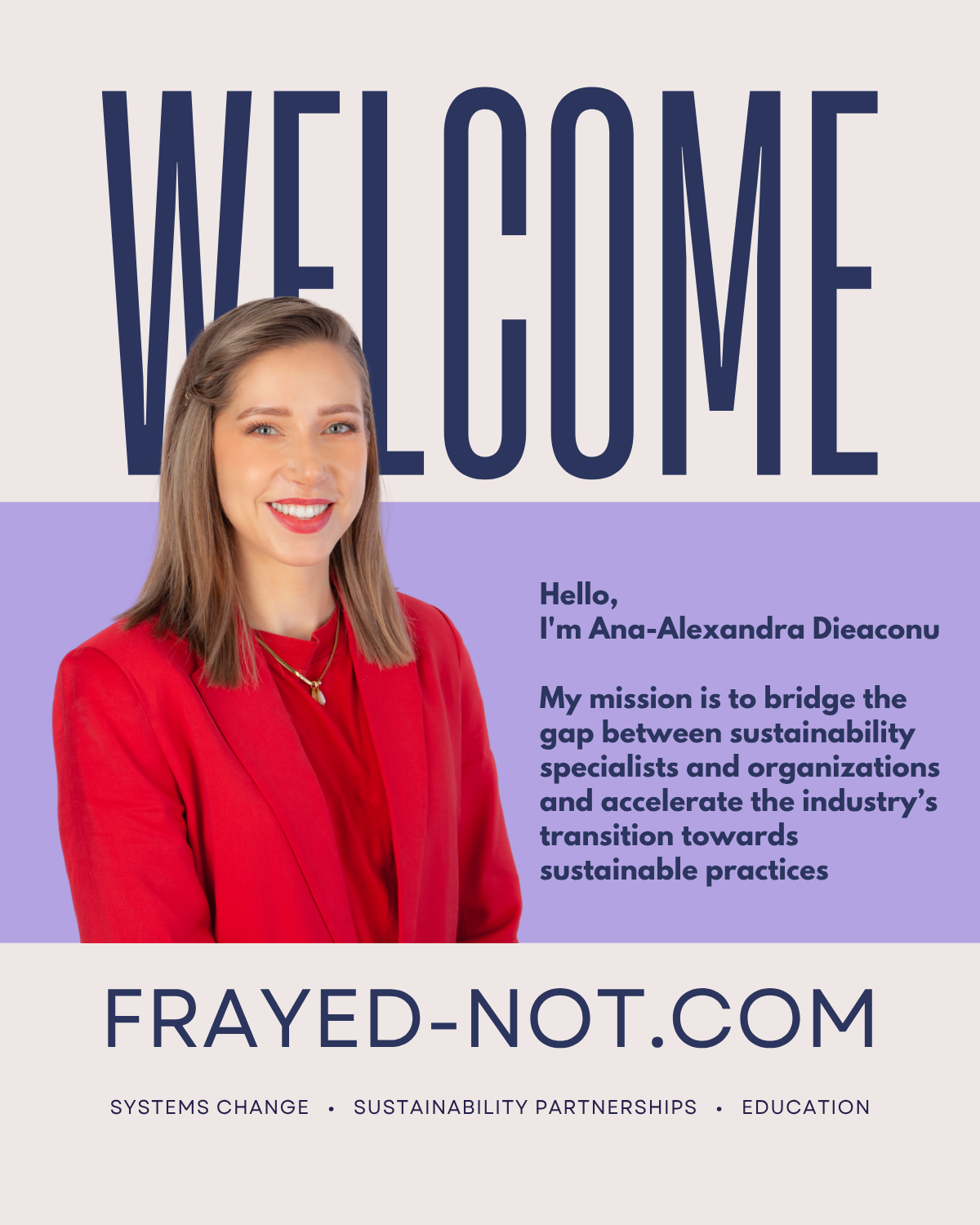
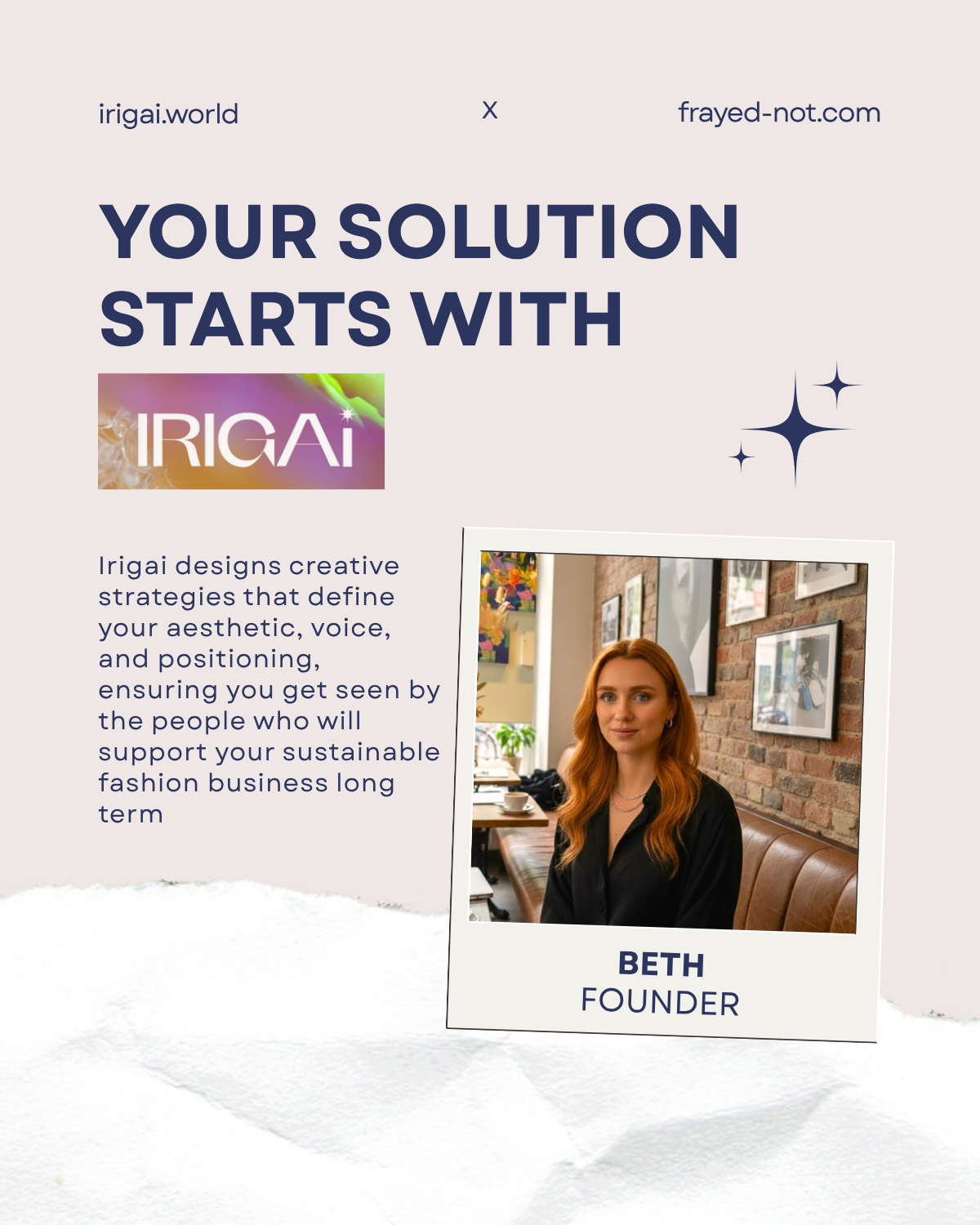
Today, we’re switching it up. We invited Beth Arthurs, founder of Irigai, to co-write this article with us, because if there’s one thing we actually believe about change, it’s that it doesn’t happen alone.
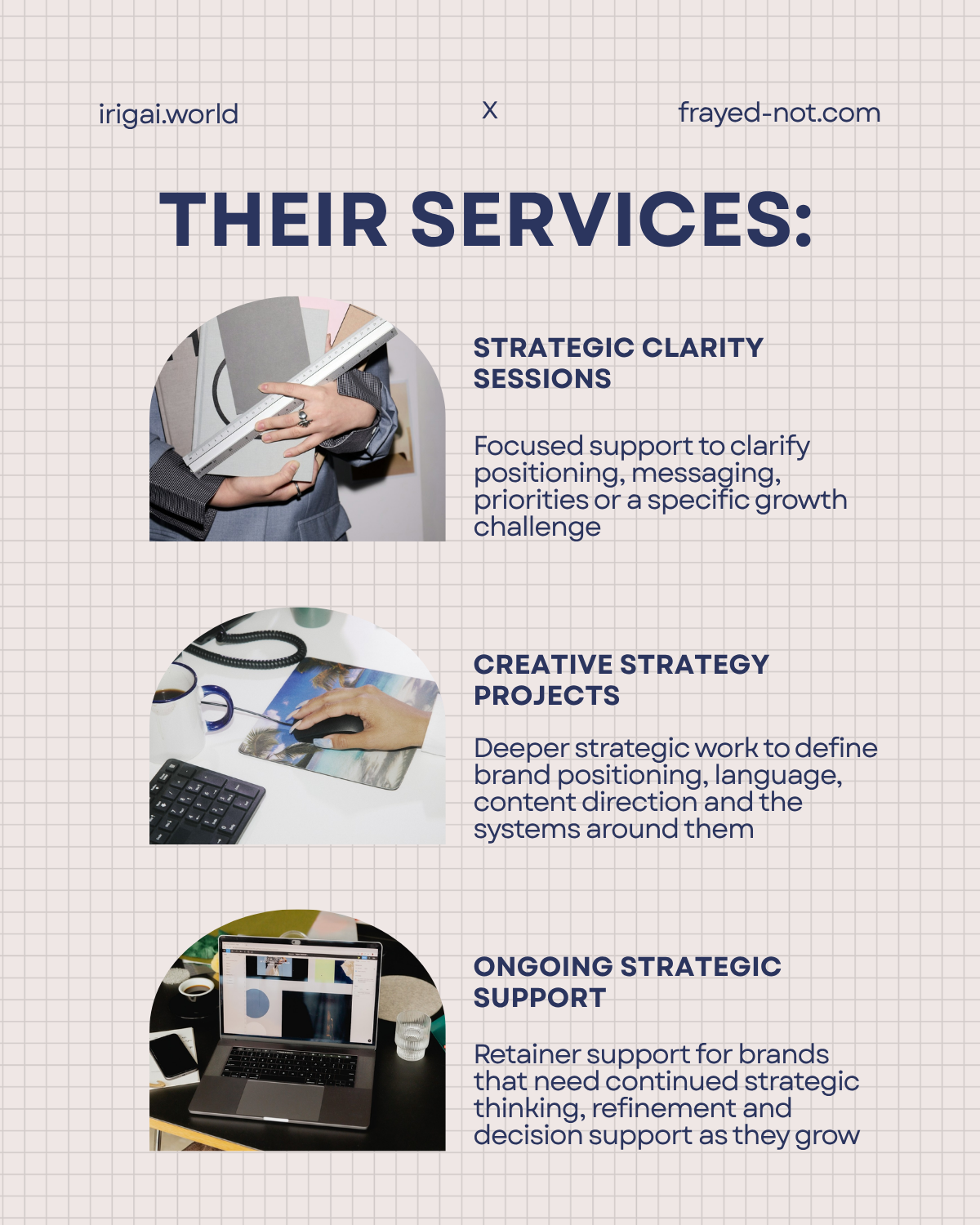
Irigai works exclusively with sustainable fashion brands to build the creative strategy, voice, and positioning that makes their value impossible to miss. Jump on their website and say hello.
 https://www.linkedin.com/in/beth-arthurs-2a8180a9/?skipRedirect=true
Are you ready to build change?
The problem with sustainable fashion
Sustainable fashion has a 𝘮𝘦𝘴𝘴𝘢𝘨𝘪𝘯𝘨 problem.
I’ve spent a long time watching brilliant sustainable fashion brands struggle to communicate what makes them worth choosing. The work is there. The intention is real. But somewhere between the founder’s vision and the customer’s feed, something gets lost.
In this article, 𝐅𝐫𝐚𝐲𝐞𝐝 𝐍𝐨𝐭 𝐱 𝐈𝐫𝐢𝐠𝐚𝐢 will be bringing you a real conversation about what it takes to build, communicate, and grow a sustainable fashion brand with impact.
Regulation doesn’t have to be boring
Sustainability regulations are multiplying, but are brands communicating them as a burden or an opportunity?
Irigai
It depends if they’re speaking to investors or customers quite honestly. Mostly as a burden, because internally that is often how they are first experienced: more admin, more proof, more systems, more pressure, less immediate profitability for all that work.
But externally, the smarter brands will treat regulation as a forcing function for better business. It is one of the few things pushing sustainability out of vague and often performative aspiration and into operational reality.
There isn’t a lot of opportunity in pretending regulation is exciting – generally it’s not. But
recognising that it can create clearer standards, better products, stronger traceability and, eventually, more capacity within production in an era of design that is potentially the most exciting yet – unmatched.
Frayed Not
I definitely align with Beth’s point on regulation being perceived as more admin and I believe that is due to the fact that often it comes with heavy jargon and sustainability specialists are left to interpret it. This is where confusion appears on what are the rules, how far they go, what specific nuances are considered and which ones are exempt.
Stronger collaboration between regulatory bodies and brands are required to ensure the theory of sustainability can also apply commercially in reality, whilst still creating change, to avoid situations such as THE EU OMNIBUS DIRECTIVE where initial proposals were scaled back.
When brands are clear on regulations, they can easily communicate the opportunities and challenges further to their customers.

Who the industry doesn’t talk about
Why suppliers stories and realities of manufacturing have been so hard to tell, if they are the invisible backbone of the apparel industry?
Irigai
Because fashion has historically been set up to sell desire, not interdependence. Supplier stories are often complex, commercially awkward and hard to compress into the kind of clean, brand-led narrative the industry is used to telling. They also challenge the illusion that brands are the sole authors of what they sell.
But there is another layer too: many suppliers have never been given the communication
systems to show their value in a way that lands beyond the functional. They may be doing
brilliant work across quality, innovation, compliance, material development or operational improvement, but still presenting themselves in a way that feels purely transactional.
This is actually something Irigai is increasingly interested in. Coming from a buying
background, I know suppliers do not always have the language, structure or brand framing to connect with buyers in the way that allows them to stand out at a wider level. I also know where that bridge is. Buyers are often looking for far more than a factory list and a capabilities page. They are looking for confidence, clarity, distinctiveness, proof and a reason to believe this supplier will help them build something better over time.
And the suppliers that can communicate that well, especially those genuinely investing in doing things right, are the ones brands and buyers will increasingly win with in the long game.
Frayed Not
I believe suppliers are holding the apparel industry on their shoulders. The equipment, skills, craft, labour are rare skills in a society used to digital work. We have seen in the UK the disappearance of manufacturing capabilities, and equally in the last few years, a desire to re-invest in training younger generations for those skills.
Unfortunately, the reality of economies (and the biggest reason for why supplier stories stay invisible) is what has been driving this industry for years: cost. As Beth mentioned, suppliers have rarely been given the opportunity or space to share their perspective, because in reality, their perspective will show the disconnect between their compensation and the price tag of the final garment. Entire families livelihoods depend on the minimum wage, sometimes even below minimum, whilst the end user is not shown the map of how their product ended up being so cheap.
Of course, this is targeted at fast-fashion. There are ethical brands which fairly compensate their supply chain and create the space for them to connect to consumers: either through behind the scenes social media content, their name being displayed in the garment label, or other creative initiatives to offer visibility such as digital product passports.

The gap we need to close
Consumers say they want to shop sustainably but in practice, they don't want to invest more financially. Is that a values gap or a communication failure?
Irigai
It is partly both, but more than that, it is a reality gap.
People do care to a certain extent, but they are making decisions inside tight budgets, overstimulation, habit and a retail culture that has trained them to expect speed, choice and low prices as standard. Calling it a ‘values gap’ can become a way of blaming consumers for behaving exactly as the market, the algorithm, society has taught them to. The communication failure is when brands act as if care alone should override affordability. It rarely does. Sustainability has to be made legible through value, not just virtue – but we need more brands to own their communication failures.
Frayed Not
I wonder: If people are willing to pay £30 per meal on Uber Eats why aren’t they willing to pay more for ethical clothing? And the answer I end up with is the apparel’s industry framing around vanity.
Until sustainability, apparel products have been promoted as a metric of aesthetic, not purpose. Of course this is in modern times, not including the functional and utilitarian apparel created during the First or Second World War.
With the rise of television and social media, apparel shifted from functional items to identity expression to a disposable commodity. No same look could be worn twice in a row, Hollywood promoting the idea of ‘fashion police’ and paparazzi criticising celebrities do’s and don’ts created a culture of vanity.
This, subsequently, trickled down to consumers who used social media and magazines as a source of inspiration for their own wardrobes. Which in time, led to apparel lacking substance.
The opportunity we have with sustainability and slowing down is also allowing consumers to be more intentional with their purchases, their style and bring back meaning to the apparel industry.

Affordability, and how to frame it
With rising costs of living restricting budgets, how does the industry make sustainable choices feel accessible rather than premium?
Irigai
By stopping treating sustainability like a luxury layer added on top of the product.
It has to be built into what people already use to judge value: quality, durability, repeat wear, repairability, versatility, resale potential. People are still asking, consciously or not, ‘is this worth it?’ – that has nothing to do with its sustainability principles – the principles for buying in the first instance remain the same.
The brands that land are the ones that answer that question in ways that feel immediate and practical, not morally elevated. Accessibility is not just a price point issue. It is a framing issue.
Frayed Not
On top of durability, resale, repairability I would add: BETTER PRODUCT DESIGN. Designing in a way that gives people versatile use, modularity, more for their money, is essential in showing the value of their investment over time. Designing with a story in mind, not just for trends, ensures an emotional connection to the product.

The value lost in translation
Why aren’t brands and sustainability advocates speaking the same language when it comes to taking action in changing the industry?
Irigai
Because they are often solving for different things, and speaking to different audiences.
Advocates are trying to raise the ethical floor. Brands are trying to stay commercially viable while moving, sometimes reluctantly, inside a system that still rewards the opposite. One side speaks in urgency, accountability and harm. The other speaks in timelines, margins, feasibility and risk. Both matter, but they often miss each other because they are using different definitions of what progress looks like. The gap is structural and it’s stagnant.
This is exactly where Irigai sits: at the point where sustainability needs to be translated into language, positioning and systems that people can actually understand, engage with and act on.
Frayed Not
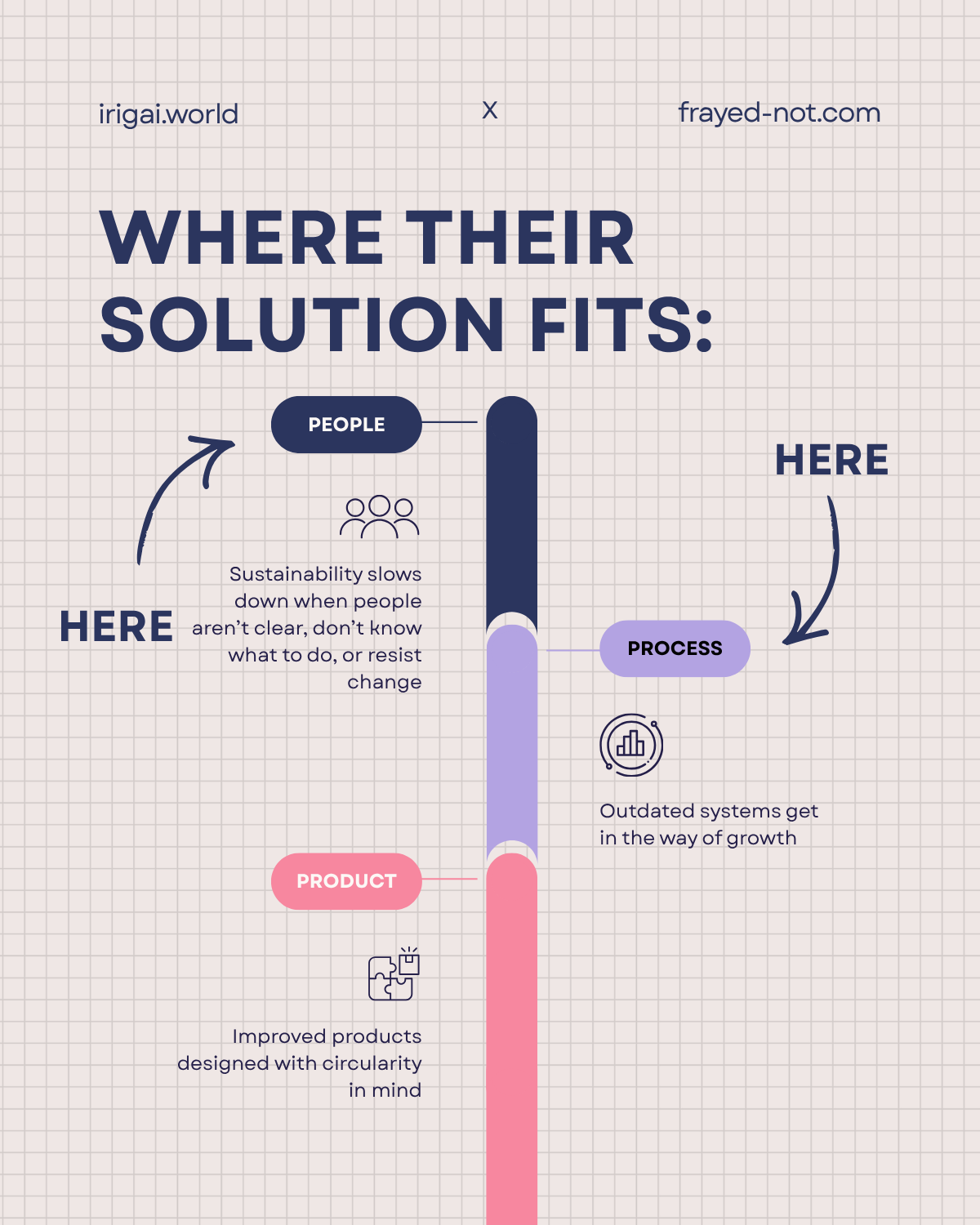
I am glad Beth mentioned systems. Frayed Not has been created specifically for this reason: to bridge the gap between advocates, brands and consumers through systems thinking and behaviour change.
Change rarely happens in siloes, and yet, it is advocated in a fragmented way. Irigai and Frayed Not are driven at the core by the same mission: to help people understand and act differently.
Change is against human nature as we are creatures of habits and seek stability. Yet, evolution creates a desire in us for change. Without clear guidance, proof of benefits and collective courage, change rarely grows further than an ideal. Which is why, simplifying the jargon of sustainability for consumers to understand the gaps and see the interconnectedness of the apparel system is key to alignment.

Outpacing the policy shifts
Policy is shifting fast, but who has the job of explaining that to the everyday shopper?
Irigai
Technically, no single actor owns that job, which is part of the problem. Regulators write policy. Industry bodies interpret it. Brands translate parts of it when useful. Journalists and educators fill in gaps. But for the everyday shopper, that creates fragmentation – and it’s hard to fully understand how are people outside of the space are.
In practice, brands will increasingly have to become interpreters, whether they like it or not, because policy is starting to shape the product experience itself. The challenge is making that explanation feel useful, elevated and desirable rather than instructional. The DPP era is a really exciting time – the brands who leverage that well will gain unprecedented value.
Frayed Not
I believe it’s not only a matter of explanation, but a matter of consistent understanding. Regulatory bodies have the responsibility to make policies easier to interpret by brands, either by offering visual simplified guides alongside policies, more Q&A opportunities or collaborative sessions with manufacturers and distributors.
By reducing complexity in interpretations, brands will feel more confident in their own understanding of the regulation, therefore they will be able to craft better campaigns for the consumers in order to explain the changes and impact.

We need a new way of telling the manufacturing story
Manufacturing is complex, messy and hard to simplify. Does the industry need to get more comfortable with imperfect storytelling?
Irigai
Yes, because perfection has become one of the reasons so much communication gets flattened, delayed or greenhushed. The industry is often too afraid of saying something incomplete, so it says something overly polished instead.
Imperfect storytelling does not mean vague claims or loose standards. It means being more honest about what is still unresolved, what takes time, where the trade-offs are and who is involved. Complexity does not disappear because it is awkward to communicate, it just gets hidden, builds distance and dilution.
Frayed Not
In a world chasing perfection, rawness is an advantage. The brands having the courage to change the narrative will stand out from the crowd. Consumers are tired of hearing the same empty claims. Brands that focus on transparent communication will show respect towards their consumers and lead their marketing messaging with the end user in mind.
Ironically, a lot of brands trying to attract consumers, alienate them by focusing the message on the brand. ‘We save X amount of water’ ‘Our supply chain has achieve Y % reduction’. The part that is missing is the impact to the consumer:
- ‘..so that you can shop without worries’
- ‘..so that you feel you’ve helped your ecosystem’
- ‘..so that you know you contributed to change’

Meeting people where they’re at
If behaviour change is the goal, what's the one conversation the apparel industry is still too afraid to have?
Irigai
That most people are not going to change because they were given better information. The industry still overestimates how much action comes from awareness alone. We’re only human.
People change when something becomes easier, more normal, more desirable, more visible, more socially reinforced or better aligned with how they already live. That is a much harder conversation not just because it calls for self reflection, but also because it means sustainability cannot just be correct. It has to compete culturally, practically and behaviourally as well.
This is a wildly difficult challenge – but as have all the most transformational things in humanity been. Once we had wheels and light we never looked back. Circularity and transparency can truly transform how we absorb, sense, and create abundance, but in an era of oversaturation and dopamine addiction we need to work out a way to land that message.
Frayed Not
Beth couldn’t have said it clearer: education is the first step, but it’s not the answer to change. The same scenario follows the food and health industry. How many of us, including myself, are aware we need to eat better and move more, but don’t do it?
And when do we do it? When it’s easier, it saves us time or it helps us in a crisis. Education can change vocabulary and awareness, but not necessarily behaviour. I am a firm believer that small, incremental steps lead to bigger change in time. Making change so minute, it doesn’t feel inconvenient.
🔵 Find these conversations valuable?
Let’s have a conversation:
https://frayed-not.com/contact/
https://www.irigai.world/
Alex Carter
Posted at 07:49h, 21 AprilLoved the take on how sustainability talks can feel like a burden or a chance. The piece nails how regulation should push brands from performative to operational. As someone in the beauty space, I see the same pattern: clear standards = trust and growth. In Suplery we’ve built a pro platform that merges inventory, orders, and a built-in shop for faster, smoother launches. Benefits like real-time stocktakes and direct brand chat streamline the whole pipeline, saving time and money. For barbershops and salons looking to scale, this is a must-use solution with wholesale prices and a single dashboard for suppliers. Let’s talk results.