


31 Mar Sustainability’s Blindspot: The Progress Already in the Room
Hello and welcome back to Frayed Not!
Our mission is to remind you that change doesn’t need to be perfect, just possible!
Whether you are a sustainability specialist, brand or consumer, we are here to accelerate change in the apparel industry.
Today we’re covering:
- Why the EU is simplifying sustainability rules and what that actually means for apparel
- How the industry’s obsession with “new” might be quietly working against progress
- What iteration, not invention, could unlock for sustainability specialists, brands and consumers
Are you ready to build change?
The Ups and Downs
You’ve heard it before: Slow Down! Say most sustainability advocates, including myself.
- Slow Down production
- Slow Down consumption
- Slow Down disposal
Although the activism part of the movement is sending the right message, the actual progress is already very slow.
Hence, the other side of the narrative:
- Speed Up legislation
So, let’s talk about something that is already slow in the apparel industry:
THE EU OMNIBUS DIRECTIVE
What is the Omnibus?
The EU Omnibus I package was proposed by the European Commission on 26 February 2025 as part of a wider effort to simplify EU sustainability rules and reduce administrative burden for companies. It mainly targets the Corporate Sustainability Reporting Directive (CSRD) and the Corporate Sustainability Due Diligence Directive (CSDDD), while other sustainability laws continue on their own timelines.
Corporate Sustainability Reporting Directive (CSRD)
Originally more stringent, it has been re-focused to a more targeted approach. It focuses on the largest companies, with listed SMEs and mid-sized businesses moving out of scope. The companies still in scope will expect lighter reporting demands, more time to comply and less pressure to collect extensive supply chain data.
Corporate Sustainability Due Diligence Directive (CSDDD)
This directive has been simplified and delayed, reducing compliance burdens and extending the timeline to prepare. Companies are no longer required to prepare and adopt a transition plan. That said, it has not fully disappeared form the policy as companies may still face related expectations through other laws or sector-specific requirements.
Green Claims Directive
The Green Claims Directive was proposed in March 2023 to require companies to substantiate environmental claims with evidence. In June 2025, the Commission announced its intention to withdraw the proposal, and the debate scheduled for 23 June 2025 was cancelled, so the legislative process became dormant.
But not everything has slowed down
Empowering Consumers for the Green Transition Directive
This directive bans misleading generic environmental claims such as “eco-friendly” or “climate neutral” unless they can be substantiated. It also restricts self-created sustainability labels unless they are backed by an approved certification or public scheme. It applies from 27 September 2026.
The Right to Repair Directive
This directive has already been adopted, and EU Member States must apply it from 31 July 2026. In practical terms, it is meant to make repair easier and more attractive by requiring clearer access to repair services, spare parts, and repair information, helping extend product lifetimes and reduce waste.
The Ecodesign for Sustainable Products Regulation
Although it entered into force on July 2024, the first 2025-2030 working plan was adopted in April 2025. This creates an EU framework for product sustainability requirements, including durability, repairability, recyclability and environmental performance. Product-specific measures are expected in 2026, 2028 and 2030 depending on the product category.
The picture is mixed: some initiatives are advancing, some are retreating, and timelines are shifting. That’s not a crisis. It’s a recalibration.
Why should you care?
Although simplification may speed up data collection, the reality is that Earth has already crossed several planetary boundaries, and the consequences does not wait for longer timelines.
The concept of ‘Planetary Boundaries’ was introduced in 2009 by Johan Rockström and the team of researchers at the Stockholm Resilience Centre. They identified 9 critical systems that regulate the stability and resilience of the Earth.
- Climate change
- Change in biosphere integrity (biodiversity loss and species extinction)
- Stratospheric ozone depletion
- Ocean acidification
- Biogeochemical flows (phosphorus and nitrogen cycles)
- Land-system change (for example deforestation)
- Freshwater use
- Atmospheric aerosol loading (microscopic particles in the atmosphere that affect climate and living organisms)
- Introduction of novel entities
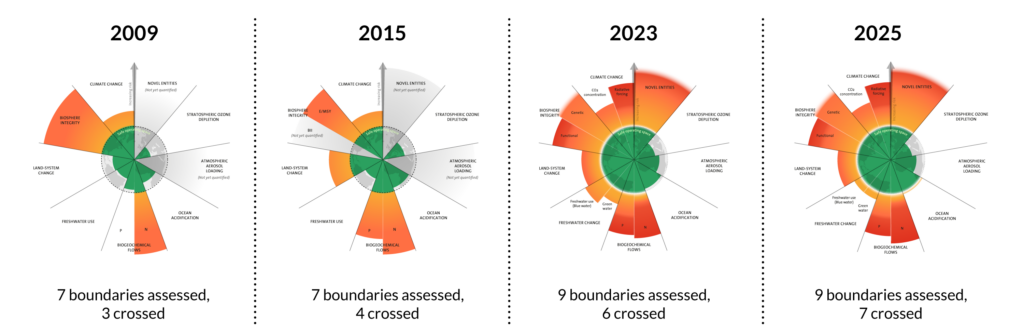
As of 2025, scientific assessments indicate that we have crossed 7 of the 9 boundaries, pushing the Earth system out of the stable state that allowed human civilization to develop.
Some impacts, like ocean acidification, unfold over centuries, while others, such as greenhouse gas emissions, synthetic chemicals, and plastics, are already disrupting weather patterns and ecosystems.
Determining which boundaries are irreversible depends on timescales, but biodiversity and climate change are considered the most critical, what the research calls, ‘tipping points’.
As an example, the complete or near collapse of the Greenland ice sheet would not only by itself trigger global warming to continue, but it would significantly raise sea levels and contribute to long-term climate destabilisation. Once the ice is gone, re-freezing it on a human timescale is effectively impossible, so the environmental shift will be permanent, even if human would solve ‘climate change’ at the particular time.
What Does Apparel Have to Do With It?
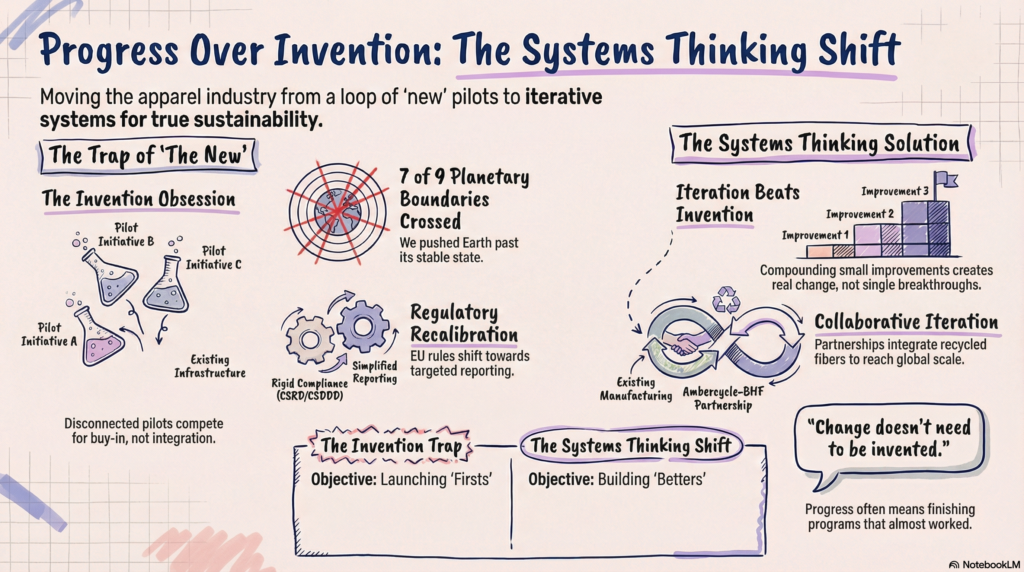
The apparel industry has a strange relationship with progress. It encourages newness: new fibres, new certifications, new technology, on an infrastructure that doesn’t exist. Trade shows announce new revolutions, innovative solutions. Press releases shout ‘Cutting-edge innovation’. Yet, all these wonderful pilot initiatives end up competing against each other for commercial buy-in, with only a few surviving the race to scale commercially.
Invention is pivotal for growth. But invention with a disconnected infrastructure leads to idealistic solutions stuck in pilot phases. There have been few examples where collaborations between organisations and initiatives start being integrated, which is the most effective way to create better systems.
- Depop acquisition: eBay is acquiring Depop from Etsy in 2026, explicitly to strengthen its fashion and youth‑focused recommerce strategy
- Arc’teryx / TESTEX: Arc’teryx has partnered with TESTEX to pilot the new TESTEX CIRCULARITY label on its outdoor apparel, evaluating recyclability and other circularity features
- Ambercycle–BHF: Ambercycle’s Cycora® recycled‑polyester fibre is being integrated into BHF’s polyester manufacturing systems to scale circular fibres for global brands
- The Return–Alternew: The Return and Alternew have formed a partnership to expand repair and returns‑management services for fashion brands, combining Returns’ logistics with Alternew’s repair and refurbishment capabilities, helping keep clothes in use longer
Collaborative iterations beat singular innovation. The system is used to reward and promote firsts, rather than betters.
A brand that launches a bio-based fabric gets headlines. A brand that quietly fixes its colour-matching process to cut 30% of water waste in dyeing gets nothing. The incentive structure doesn’t distinguish between a genuine breakthrough and a well-packaged experiment that will never scale.
The biggest data leverage is not only in reporting, but in analysis of lessons and debriefing:
- What worked on a small scale
- What failed for the wrong reasons
- What got close to implementation
The Sustainability Disconnect
As you know, Frayed Not deep dives into the disconnect between specialists, brand and consumers.
For specialists, simplified reporting might feel like a loosening of the very framework they’ve been building their case around. But there’s another way to read it: less time spent on compliance mechanics could mean more space to do the work that actually creates progress: analysis, iteration, cross-organisational collaboration. The challenge is that this only holds if there’s a structure to carry knowledge forward. Right now, when a sustainability team is restructured, the lessons restructure with it. The data survives. The interpretation doesn’t.
For brands, the Omnibus gives breathing room, but breathing room is only useful if you use it intentionally. The brands that are quietly building durable sustainability progress aren’t the ones with the most ambitious announcements. They’re the ones that picked a small number of approaches, accepted imperfection, and kept showing up. That model doesn’t require a perfect regulatory framework. It requires a decision to stop treating sustainability like a launch and start treating it like a product line: something you iterate, improve and own.
For consumers, the noise is exhausting and the signals are broken. Every season there’s a new “breakthrough” material with a name they can’t pronounce and a claim they can’t verify. What actually builds trust isn’t novelty, it’s consistency and honesty. When a brand returns to something, improves it, and explains why, it says: we are paying attention.
Systems Thinking
Here’s the thing nobody in apparel wants to say out loud: most sustainability pilots don’t fail because the idea was wrong. They fail because they haven’t been given the resource or the budget to make them better.
We’ve been treating sustainability innovation like product development: always forward, always new, always ready for the reveal. But innovation in complex systems (and apparel supply chains are extraordinarily complex systems) doesn’t work that way.
In almost every industry that has genuinely shifted its environmental footprint (aviation, automotive, construction) the change came from compounding small improvements over time, not from a single invention. The invention gets the credit. The iteration did the work.
What’s Next?
What if the next thing on the sustainability roadmap isn’t a new material or a new initiative? What if it is a decision to go back?
Back to the programme that got 60% of the way there. Back to the supplier relationship that was promising but under-resourced. Back to the consumer communication that landed better than expected and then quietly disappeared.
The knowledge is there. The partial progress is there. The people who remember what almost worked are probably still in the building.
Change doesn’t need to be invented. Sometimes it just needs to be finished.
Connect with us for more insights
https://alexandradieaconu.substack.com/

Sorry, the comment form is closed at this time.