

18 Feb Ignore colour and shape, and your designs are headed for landfill
Does the garment your team is about to approve actually stand a chance of being worn more than twice?
Hello and welcome back to Frayed Not!
Our mission is to remind you that change doesn’t need to be perfect, just possible!
Whether you are a sustainability advocate or sustainability specialist, we are here to support those that carry the real weight of change so sustainability moves from strategy to execution.
Today we’re covering:
- Why colour, silhouette, and usability are sustainability decisions, not just aesthetic ones
- How design psychology directly shapes consumer behaviour and textile waste outcomes
- What you can do right now to influence design decisions upstream, before the damage is done
Are you ready to build change?
CONTEXT
The Problem Starts at the Drawing Phase
Here is something that rarely gets said loudly enough in sustainability circles: most textile waste is not an accident. It is a design outcome. It is the logical result of choices made months, sometimes years, before a garment ever reaches a consumer’s hands. Choices about colour. About silhouette. About how a piece will actually feel on a Tuesday morning when someone is running late.
If you are working inside a fashion brand, a retailer, or a supply chain and trying to make sustainability more than a slide in the board presentation, this matters enormously. Because the point at which you can have the most impact is not at the recycling bin. It is at the brief.
The fashion industry produces somewhere between 80 and 100 billion new garments globally every single year. Globally, approximately 92 million tonnes of textile waste are generated each year, and 87% of materials used for clothing end up in incinerators or landfills, with only 1% recycled into new garments. These are not statistics about bad luck. They are statistics about bad systems, and bad systems are built from accumulated decisions that nobody questioned at the right moment.
This article is about giving you the tools to question them earlier.
Design psychology is the study of how aesthetic and functional choices shape human behaviour. In fashion, it means understanding that a garment’s colour, cut, and wearability are not just creative expressions. They are behavioural nudges. And when those nudges point in the wrong direction, they send clothes straight to landfill.
FACTS and STATS
Colour Is Not a Mood Board Decision. It Is a Behavioural Signal
Consumers form near-instant judgements about a garment based on colour alone. Before they check the label, before they feel the fabric, before they read the price tag, they have already made a sub-conscious assessment of whether this piece is for them. Whether it will work with what they own. Whether it looks like it will last.
When a brand selects a colour palette that does not align with how its target customer thinks about value, versatility, or durability, it is not making a creative misstep. It is making a waste decision. Garments bought impulsively on the strength of a trend-driven colour and then abandoned because they match nothing else in a wardrobe become textile waste faster than almost any other category.
Research into consumer colour psychology consistently shows that palettes associated with practical versatility and longevity tend to generate higher wear frequency. Earthy neutrals, tonal ranges, and colours that signal quality craftsmanship rather than seasonal novelty perform better across longer periods of use. In the average household, one in three clothing items has not been worn in the past year. That is a wardrobe full of garments that failed to earn their place, and colour mismatch is a significant contributor.
The practical implication for brands is deceptively simple: test your colour stories with real shoppers before you commit to production volume. Not just for appeal, but for wear intention. Do they plan to wear it once or often? Does it work with clothes they already own? The answers will tell you more about likely waste outcomes than any post-consumer recycling plan.
Silhouette Shapes Behaviour as Much as It Shapes the Body
A garment’s silhouette carries enormous behavioural weight. When a shape is trend-driven to the point of impracticality, it has a built-in expiry date. The wider that trend window closes, the faster those garments move from wardrobe to donation bag to landfill.
Designing with modularity, timeless proportions, and genuinely adaptable fits is not a compromise on creativity. It is an upstream sustainability intervention. Pieces that work across body types, that transition between contexts, and that do not depend on a specific moment in the fashion cycle to feel relevant have dramatically longer active lifespans. And a longer active lifespan means lower replacement rates, lower returns, and lower waste.
The fashion industry’s footwear and garment sectors together are responsible for approximately 8% of global greenhouse gas emissions. A meaningful portion of that footprint sits in the production of items that will be worn fewer than five times. Silhouette decisions made at the brief stage have a direct line to that number.
The ask here is not for brands to abandon creativity or pivot entirely to basics. It is to build durability into the brief as a non-negotiable parameter alongside trend relevance. Garments that work longer reduce the need to produce more
Usability Is Where Good Intentions Go to Die
This is the one that gets overlooked most often, and it is possibly the most consequential. A garment can be beautiful. It can be responsibly sourced. It can be made from recycled or organic materials. And it can still end up in a landfill within six months because wearing it is uncomfortable, because the seams pull, because the fabric pills after two washes, or because the cut does not work in the context of how people actually live their lives.
Comfort, stitch quality, and material behaviour in real-world conditions are not finishing touches. They are core sustainability metrics. A piece that people reach for repeatedly, that holds its structure through regular wear and washing, and that feels good to put on stays in circulation far longer than one that ticks every ethical sourcing box but fails in everyday use.
Only 20% of discarded textiles are collected for reuse or recycling globally. The other 80% is largely unreachable by the time it is discarded. The only lever that reliably reduces that figure is extending the time before discard happens in the first place. Usability is that lever.
Brands that introduce shopper trials and post-purchase feedback loops before scaling production are already operating with this understanding. They are treating wear experience as a design input, not an afterthought.
IMPACT FOR YOUR CLIENTS: Why This Is Your Conversation to Lead
If you are a sustainability advocate working inside a brand or with retail clients, here is the tension you are probably living with daily: the decisions that most affect sustainability outcomes are often made in rooms you are not invited into.
Design reviews. Range planning meetings. Colour sign-off sessions. These are where the real waste is decided, and sustainability teams are typically consulted after the fact, if at all.
Design psychology gives you a language to enter those rooms earlier and with more credibility. Because you are no longer just making ethical arguments, you are making commercial ones. Returns cost money. Deadstock costs money. Trend-driven styles that lose relevance before they reach the shop floor cost money. When you can show that colour, silhouette, and usability choices directly affect sell-through rates, return volumes, and end-of-season markdown, you have reframed sustainability as a business performance issue.
That is a different conversation. And it tends to get a different response.
YOUR ORGANISATION'S IMPACT: What Changes When Design Gets It Right
Nearly 60% of all clothing materials are derived from plastics, including fibres like nylon, acrylic, and polyester. The extraction and processing costs embedded in those materials are sunk costs the moment a garment is discarded early. Extending wear life does not just reduce waste volume. It recovers value from inputs already spent.
For organisations with sustainability targets tied to waste reduction or circular economy commitments, shifting design criteria upstream is one of the highest leverage interventions available. It does not require new infrastructure. It does not require new technology. It requires asking different questions at an earlier stage of the process.
That is a different conversation. And it tends to get a different response.
PROS and CONS
Pros:
- Commercial alignment: Framing design psychology as a route to better sell-through and lower returns gives sustainability advocates a credible seat at design and commercial planning tables.
- Upstream impact: Intervening at the design stage addresses waste before it is produced, which is categorically more effective than any downstream recycling or recovery solution.
- Long-term brand equity: Brands known for producing genuinely wearable, durable pieces build stronger consumer loyalty and are better positioned for incoming regulation around product longevity and extended producer responsibility.
Cons:
- Creative resistance: Design teams may interpret sustainability criteria as constraints on creative expression, creating friction that requires careful relationship-building and clear communication of intent.
- Timeline pressure: Integrating wear-testing and feedback loops into design cycles requires time and budget that is not always readily available, and may be deprioritised under commercial pressure.
- Attribution difficulty: The connection between a design decision and a waste outcome spans many months and multiple stakeholders, making it genuinely hard to demonstrate causality and therefore hard to build the internal business case for change.
SYSTEMS THINKING
Seeing the Whole Loop
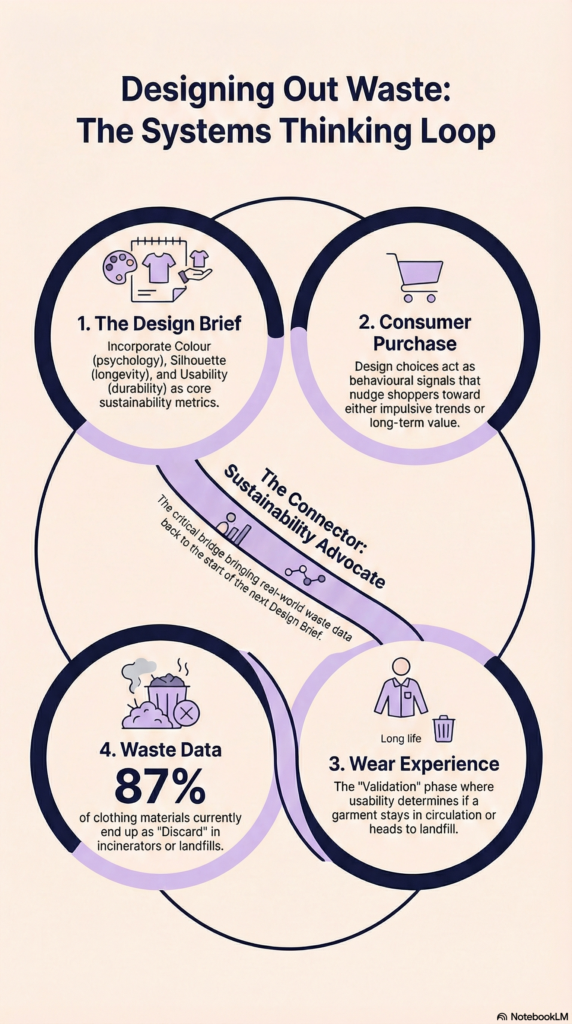
Here is where we have to zoom out. Because design psychology in fashion is not a standalone fix. It is one node in a system, and systems thinking asks us to look at the whole loop before we intervene in any single part of it.
The loop looks something like this. A brand designs a garment. The design sends signals to the consumer about quality, versatility, and desirability. The consumer buys based on those signals, either accurately or mistakenly. The wear experience either confirms or contradicts those signals. If the experience falls short, the garment is discarded. That discarded garment feeds back into the waste statistics that motivate the brand’s next sustainability report. The report influences strategy. Strategy influences the next brief. And the brief influences the next design.
The problem is that the feedback loop is too slow and too indirect. By the time post-consumer waste data reaches the design brief, it has been abstracted beyond recognition. And the people with the power to change the brief are rarely the ones looking at the waste data.
Sustainability advocates sit at a critical junction in this system. They are one of the few functions that can see both the design end and the waste end. That gives them the potential to act as connectors, translating between languages that do not naturally speak to each other. Bringing waste outcome data into design conversations. Bringing design logic into sustainability conversations. Building the bridges that the system needs to close its own loops.
This is not comfortable work. It requires operating across functional boundaries that organisations often keep firmly separate. But it is precisely this kind of cross-system thinking that creates durable change, as opposed to the single-initiative thinking that produces a great case study and then disappears.
The fashion industry’s waste crisis is not going to be solved by any one intervention. Not by recycling programmes alone. Not by material innovation alone. Not by consumer education campaigns alone. It will be addressed, slowly and imperfectly, by people who understand the system well enough to push multiple levers at once, and who are patient enough to stay in the work long enough to see the effects.
NEXT STEPS
What You Can Do Before the Next Range Review
Map the decision points. Identify where in your organisation’s product development process colour, silhouette, and usability decisions are currently made, and who is in the room when they happen. This is your map of where influence is possible.
Pilot wear-testing with real users. Identify one or two upcoming styles where you can introduce a small-scale wear-testing protocol before production scale-up. Document the findings in a format that is useful to the design team, not just the sustainability team.
Create a feedback loop from post-purchase to design. Work with customer insights or e-commerce teams to capture return reasons and wear frequency data in a format that can inform the next design cycle. If that data already exists, make sure it reaches the people writing the brief.
🔵 Find these conversations valuable?
Apply to work with us: https://frayed-not.com/contact/
🔵 Are you looking for practical frameworks?
Find us on Substack: https://alexandradieaconu.substack.com/
Cited sources:
- Clothing Waste Statistics 2025 (Best Colorful Socks): https://bestcolorfulsocks.com/blogs/news/clothing-waste-statistics
- Apparel Waste Statistics 2025 (Best Colorful Socks): https://bestcolorfulsocks.com/blogs/news/apparel-waste-statistics
- Colour theory in design and why I don’t use it (exactly): https://designslikethese.co.uk/uncategorized/colour-theory-in-design/
- The State of Fashion 2026: When the rules change (McKinsey & Company): https://www.mckinsey.com/industries/retail/our-insights/state-of-fashion
- Fashion Waste – 2025 Facts & Statistics (Waste Managed): https://www.wastemanaged.co.uk/our-news/retail/fashion-waste-facts-and-statistics/
- 10 Clothing Waste Statistics (Printful): https://www.printful.com/blog/clothing-waste-statistics

Sorry, the comment form is closed at this time.