

25 Sep Your Business Model Has An Expiry Date
Most "efficient" apparel businesses aren't efficient at all, they're scared of what changing would cost them
I know, it’s comfortable. All these years, you finally arrive at the office, mentally mapping the location of all your files, before the laptop even turns on.
‘Good day?’, a familiar voice asks, already walking away before the question mark lands.
10 a.m. – Meeting time
You are looking at a room full of people who speak a language you have completely tuned out. You can predict what they’re going to say, the disagreements between departments, the dashboard showing stagnant KPIs.
‘Why aren’t we hitting profit like we used to?’ Your mind wonders. ‘Is it the product? Is it the strategy? Is it…our business model?’
Let me tell you right now. You don’t need a new business model. You need to stop protecting the one you’ve got.
You have convinced yourself that financial security means maintaining tradition, when in reality that only keeps you afloat. Most of the time is just an excuse to avoid the discomfort of growing a business model which starts showing its age.
Welcome to Frayed Not. A space for those shaping what’s next in the apparel industry.
Today we’re covering:
- Why ‘efficient’ business models quietly inhibit growth
- The shift from product-first thinking to people-first markets
- Maximising content creation for competitive advantage
Are you ready to build change?
MONEY, MONEY, MONEY …
In the words of ABBA, most apparel business models were built around one question: how do we make and move product as cost effectively as possible?
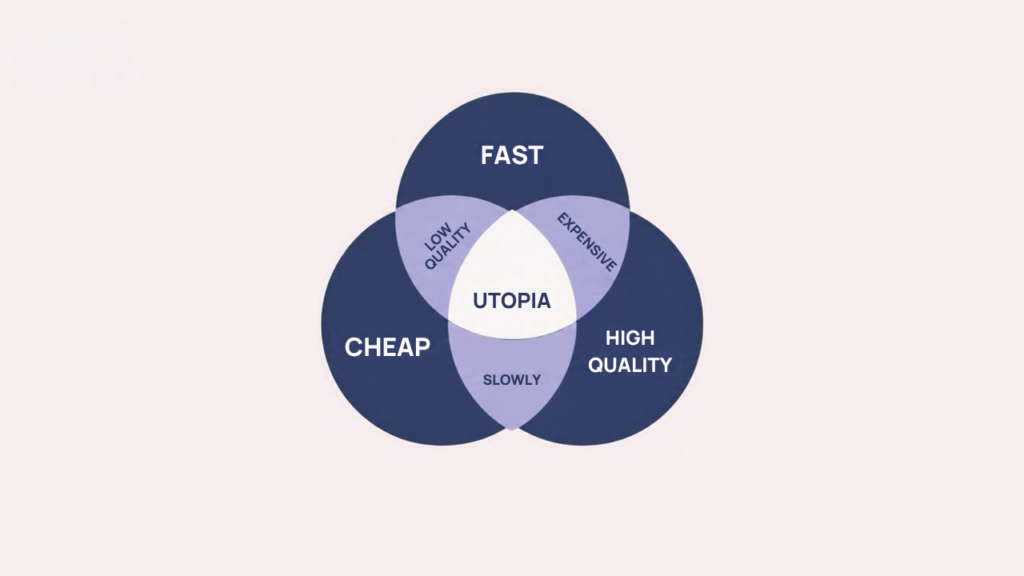
Price, quality, time … the triangle everyone is avoiding. Starting a new product development cycle forces you to check your priorities, risks and trade-offs.
Fast & Cheap?
Hello fast-fashion. Large volume of clothing is required in order to achieve low cost. The focus is on the variety of clothing offered to the customers, resembling a dopamine hit after a night of doom scrolling. Trade-off? Low quality product.
Cheap & High quality?
Rare business model, but this is mainly achieved through focusing on the brand before the product. Creating a loyal customer database who doesn’t mind waiting for the product to arrive, because they get an affordable price point in return. Trade off? Slow delivery, limited edition drops.
High quality & Fast?
Get ready for some heavy investment. This requires agile R&D, potential localised production or vertically integrated factories, bypassing traditional global supply chain. Trade off? Extremely high cost.
BUSINESS MODELS BUILT FOR YESTERDAY’S RULES
For a while, the product-first business model worked, because the market rewarded it. Design a quick garment, mass produce it and buy enough advertising space to convince people they need it. Somewhere in the last decade, consumers stopped purchasing product and started paying more attention to the relationship they have with brands.
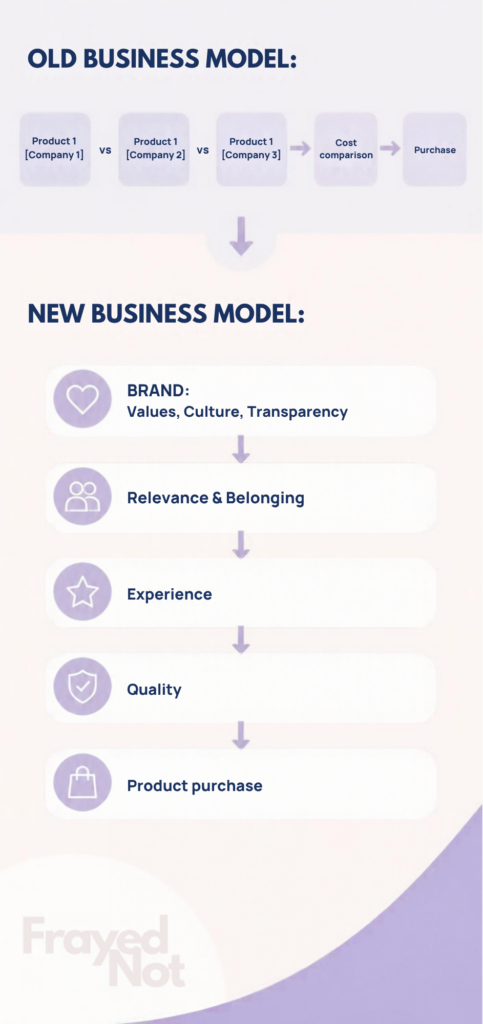
The brands that are still optimising for cost will be the first disappearing in the next 5 years.
And no, ain’t no chance of faking it! A brand that talks community, but is structurally optimised for cost-cutting will show a mismatch in services or comms and consumers will pick up on it.
So why do ‘efficient’ business models inhibit growth?
Because focusing purely on the product puts pressure on the supply chain and makes brands slower to adapt to market shifts. The result? The brand might attract customers, but it won’t be able to retain them. The audience doesn’t want another jacket, they want a product that becomes part of their lifestyle. Either through functionality, identity expression or one of a kind aesthetic.
CONTENT IS YOUR UNFAIR ADVANTAGE
So if the new business model relies heavily on belonging, how are you actually building that? A curated feed of perfectly shot products won’t save your budgets.
To build a true competitive advantage, marketing must shift from an afterthought to the core operational strategy. Instead of static product pictures, show behind the scenes of how the product is created, use interactive model thumbnails showing the story of the design. Social media platforms are not just a digital catalogue. Start using them as public research and development boards and take your customer on the product development journey.
Consumers can tell when something is overly engineered or fake. Your solution lies in radical transparency. Show the messy middle. Explain the exact cost breakdown of a garment. Prototype failed? Perfect, share it. People buy into the process before they buy into the product.
That is the core belief behind Frayed Not. Change in this industry does not have to be perfect, just possible. And that happens by aligning the three critical areas:
- PEOPLE – Alignment is where progress actually starts. You cannot build a community with your audience if your internal team doesn’t agree on the same business trajectory
- PROCESS – Complex processes waste time, but robust systems allow you to adapt without exhausting your resources
- PRODUCT – Built to perform, not only to look good. When people and processes are aligned, the product naturally answers the market’s real needs
Create space for strategic experimentation. Business model innovation requires learning cycles and your business can’t learn if you expect every experiment to bring immediate profit. It is time to start building what comes next.
Change doesn’t have to be perfect. Just possible.

Sorry, the comment form is closed at this time.